Showing posts with label Obama. Show all posts

Saturday, May 28, 2011

Don't Knock the Ryan Plan?

Joe Nocera tells us not to knock Paul Ryan. Not that he likes the plan itself:
The Ryan plan, which would give seniors a fixed amount they can use to buy health insurance, would undoubtedly shift the cost burden over time from the government to seniors themselves, making health care far less affordable for millions of people. Ryan says that “empowering” health care consumers will help control costs, but that’s absurd: Medicare itself has far more pricing power than the people who actually need treatment.
The first part of Nocera's critique is correct, the cost of health care is shifted to seniors themselves, but the second part makes no sense (though I have seen this before, see here). I wonder how people can hold such contradictory ideas in their heads at the same time? If you shift more of the costs to seniors, who have limited budgets, they will get less health care. If they pay less for health care, costs will fall. Of course so will the amount of health care provided. But you cannot deny that if people cannot afford healthcare they will buy less of it.

Indeed, that seems to be the biggest problem with the Ryan plan. It controls the costs of healthcare by forcing people to buy less than they need.

But then the confused Nocera argues that we should not scorn Paul Ryan. Because the costs of health care are real he argues that:
It would be nice if we could treat the Ryan plan not as an object of derision but as a launching off point for a serious debate. That way, maybe for once we could avert a crisis instead of acting shocked when it finally arrives.
But this seems odd to me. Why not let the Obama Plan be the start of a discussion to control Medicare costs? You don't want to scorn Ryan who argues that Obamacare destroys Medicare. But we should start the discussion with Paul Ryan?

Nocera is really confused.

Monday, December 6, 2010

I Agree with Krugman

Paul Krugman argues that President Obama should just let the tax cuts expire and I agree.

Democrats have tried to push a compromise: let tax cuts for the wealthy expire, but extend tax cuts for the middle class. Republicans, however, are having none of it. They have been filibustering Democratic attempts to separate tax cuts that mainly benefit a tiny group of wealthy Americans from those that mainly help the middle class. It’s all or nothing, they say: all the Bush tax cuts must be extended. What should Democrats do?

The answer is that they should just say no. If G.O.P. intransigence means that taxes rise at the end of this month, so be it.

Krugman thinks it is a bad deal. I think they should just let them expire based on budget realities. What would be best would be to couple this with a cut in payroll taxes. That would lower the cost of employing people and would mitigate any effect on unemployment.

But I expect the President will give in to satisfy his campaign pledge about not raising taxes on the middle class.

Wednesday, November 3, 2010

Is Obama a Keynesian?

Everybody is linking to this great video questioning Obama's Keynesian "heritage" from the March for Sanity. Worth another view.

Thursday, December 31, 2009

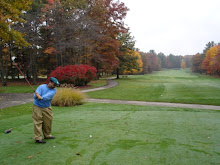
Obama and Golf

Michele Cottle criticizes the President for playing golf, and Paul Kruman approves. This is one of the stupidest articles one can read. For example,
As a senator, John F. Kennedy scored political points on Eisenhower by mocking Ike’s golf obsession--while taking pains to keep his own golfing gifts under wraps. (As Van Natta recounts, JFK forbade the media from photographing him at play.) Bushes 41 and 43 were both slammed for golfing during wartime. It has been posited that W. quit the game in part because of the stinging coverage of comments he made on the golf course in August 2002, following a suicide bombing in Israel. “There are a few killers who want to stop the peace process that we have started, and we must not let them,” Bush told the assembled journalists. “I call upon all nations to do everything they can to stop these terrorist killers. Thank you. Now watch this drive.” The tone-deaf clip eventually made its way into Michael Moore’s Fahrenheit 9/11. It was not one of golf’s finer moments.
So JFK hypocritically criticized Ike for playing golf even though he was a golfer (don't even get me started on JFK sending Pierre Salinger to buy all the Cuban Cigars he could find before announcing his boycott of Cuban imports). And George W. Bush made stupid comments on a golf course. Obama should thus quit golf because he can be falsely accused by some hypocrite? Or because a stupid President made stupid comments on a golf course?

This is what happens to liberals when they consider golf. Their minds go numb. Then there must be the ritual comment that golf is a white elitist pastime. This can only be said by a non-golfer. I played today at Wilson Golf Course in LA. The course is a United Nations meeting. I doubt there is a place in America -- except on other public golf courses -- where you get Blacks, Whites, Jews, Hispanics, and Korean Americans interacting in such a friendly, equal, manner. Obama's natural constituency plays golf at public courses all over America.

Monday, December 14, 2009

More on Credit

The President told the bankers they have to start lending to help us get out of the recession, and that they owe us this:
“America’s banks received extraordinary assistance from American taxpayers to rebuild their industry,” Mr. Obama said. “Now that they’re back on their feet, we expect an extraordinary commitment from them to help rebuild our economy.”
The President argues that credit difficulties are hurting small business:
President Obama reiterated his call Monday for the nation's banks to increase lending, saying that he was getting too many letters from small businesses unable to borrow money.
The story seems to be that the recovery is now held back because of a lack of credit. It is hard to understand what model might suggest this. The normal story is that we suffer from a lack of demand. Many observers, like Paul Krugman, have been arguing that we need more stimulus to fuel the recovery. That seems like what we need is more demand. In a recession the demand for loans declines. That is why the yield curve steepens. The quantity of credit extended depends on supply and demand. Given how low interest rates are, it is hard to believe that the recovery is really being stifled by a lack of credit supply.

Sure, we hear a lot about the troubles small businessmen are having obtaining credit. And surely banks are busy improving their balance sheets. But it must primarily be a lack of demand which hinders credit from flowing. Banking is a competitive industry. If there were companies with good collateral that were trying to borrow it is hard to believe they could not get credit.

More likely, the problem is that the quality of collateral is quite poor right now. Banks don't need more real assets. What kind of paper can companies pledge in a recession? Given that bank regulators want banks to improve their balance sheets this pressure must be what is limiting loans.

Credit and the Bankers

President Obama called the big Bankers to DC today to tell them to make more loans. See here and this article from Bloomberg. The purpose of the meeting was to "to ratchet up pressure on banks to extend more credit to small businesses and ease opposition to his regulatory overhaul."

Meanwhile,
Federal Deposit Insurance Corp. Chairman Sheila Bair said she’s “concerned” that U.S. banks are making only the safest loans. “There needs to be well-managed risk-taking to get the economy going again,” Bair said today in a Bloomberg Television interview at the White House.
Now it seems clear that credit for small business is a problem. But does it really make sense for regulators to call on banks to make more risky loans when the financial crisis arose because of excessive lending and an asset bubble?

Moreover, the whole process seems backwards to me. It was only six months ago that the Treasury was assessing the health of individual banks because we were worried about their solvency. In the wake of the financial crisis prudence would suggest that they should be worried about the quality of their balance sheets.

But the questions arise why the banks don't lend given that we bailed them out. We helped them, why don't they help Main Street? Well, one problem might be the restrictions put on those banks that took TARP money. They are paying a large price to get out of TARP, as this article in the NYTimes about Citibank suggests.
The moves will result in a $10.1 billion hit to Citigroup’s fourth quarter results, because of accounting charges taken on the value of the repaid preferred shares and the cancellation of loss-sharing agreement. The new stock offering, meanwhile, will severely dilute the value of existing Citigroup shares.
Why do it then? Clearly to get out from under the Pay Czar. It is better for the big banks to raise capital costly and pay back Uncle Sam than to be subject to the restrictions mandated by Congress. And if you are raising money to pay back Uncle Sam it must be harder to lend to Aunt Main Street. Nobody wants to mention that connection, however.

Addendum: Wells Fargo has announced that it too will repay TARP funds.

Tuesday, September 15, 2009

Obama's Speech to Wall Street

The Economist (magazine) did not like Obama's speech. I have to say I agree with their criticism. It must say something when you get compared unfavorably to George Bush's analysis:
"THIS sucker could go down.” George Bush’s verdict during the worst of the financial crisis a year ago was crude but penetrating. Barack Obama, delivering a speech in New York on September 14th to mark the anniversary of Lehman Brothers’ failure, managed the opposite trick. He produced plenty of elegant phrases but little that was new, and quite a bit that was confusing.
How can one argue for both extending financial services to those unserved and for regulations to prevent this sort of thing? How can one argue that future bailouts will not cost taxpayers? The tone is serious but the arguments are not.
The intricacies of bank reform were never likely to get a thorough airing in a set-piece political speech. But the casual listener to Mr Obama’s oratory might conclude that the crisis occurred because there were no regulations, that big banks would be allowed to fail in the future and that the proposed constraints of finance will create a new age of prosperity. (They would also think that the incomprehensible decision on Friday to impose tariffs on Chinese tyre imports was designed to save free trade.) The truth is far messier. Reform is badly needed, but people will still be greedy, banks will still need saving and a more stable system will entail less credit flowing through it. Mr Obama is eloquent but too often he does not tell it like it is.
That last part just about says it.

Wednesday, July 8, 2009

President Obama comes to NES

As everybody knows by now, President Obama gave the commencement address at NES' 16th annual graduation. It was a great occasion for NES, a real coming out party.

It was a special honor for me to welcome the President and First Lady to our commencement.

You can see the whole speech here. Visit the NES website for more, here.

One thing I should mention. Some of the press commented that the response of the NES crowd to the speech was respectful but not enthralled. I think this is incorrect. There was no applause during the speech, but that was out of respect. The crowd was totally into the speech, and enjoyed it immensely. But nobody felt comfortable applauding in the middle.

But to say that the audience was not enthusiastic is totally off base.